
Guide
Translate Arabic voice to English: Arabic audio and voice messages
Got Arabic audio you cannot follow? ReplyLingo does Arabic to English voice translation for voice messages, WhatsApp notes and audio files, and lets you answer back in Arabic.
Last updated: November 2026
The short answer
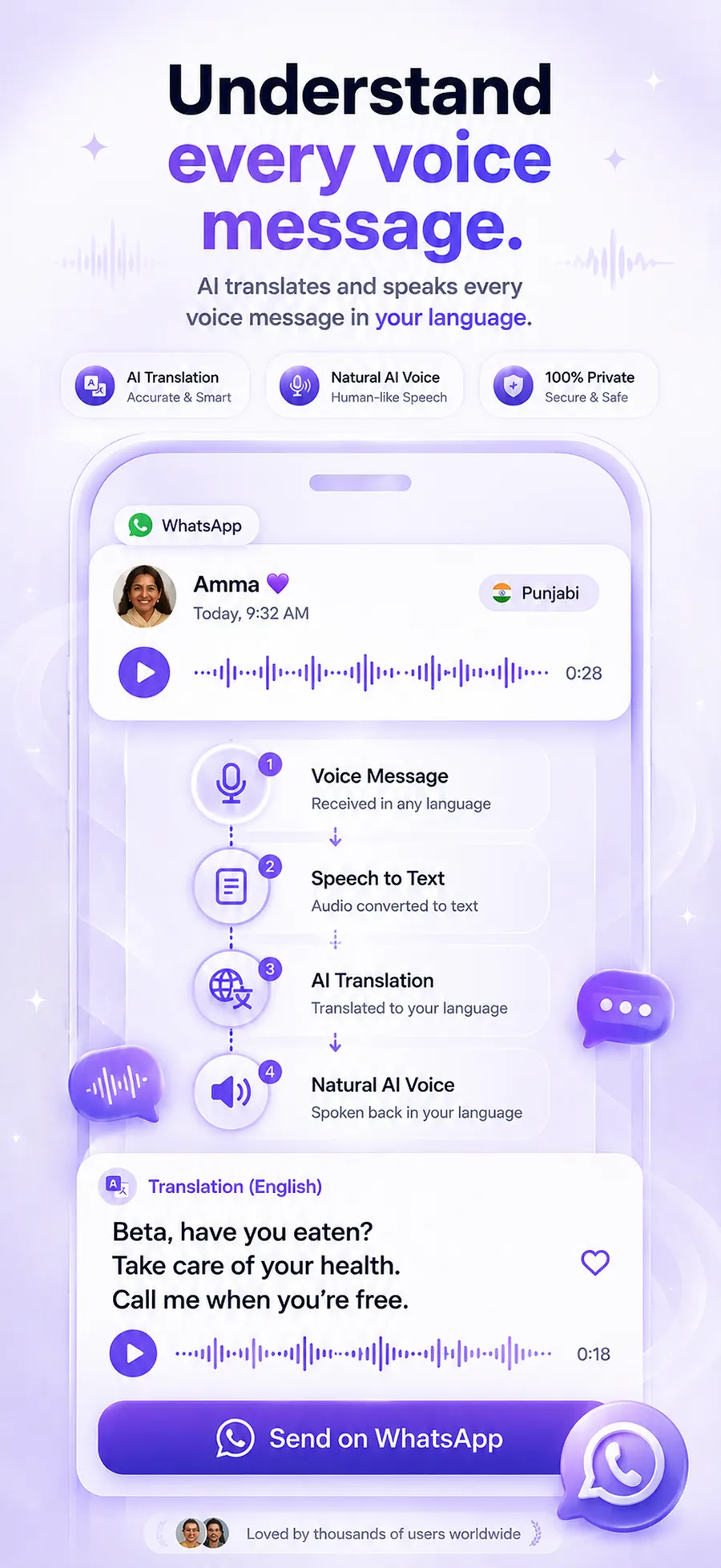
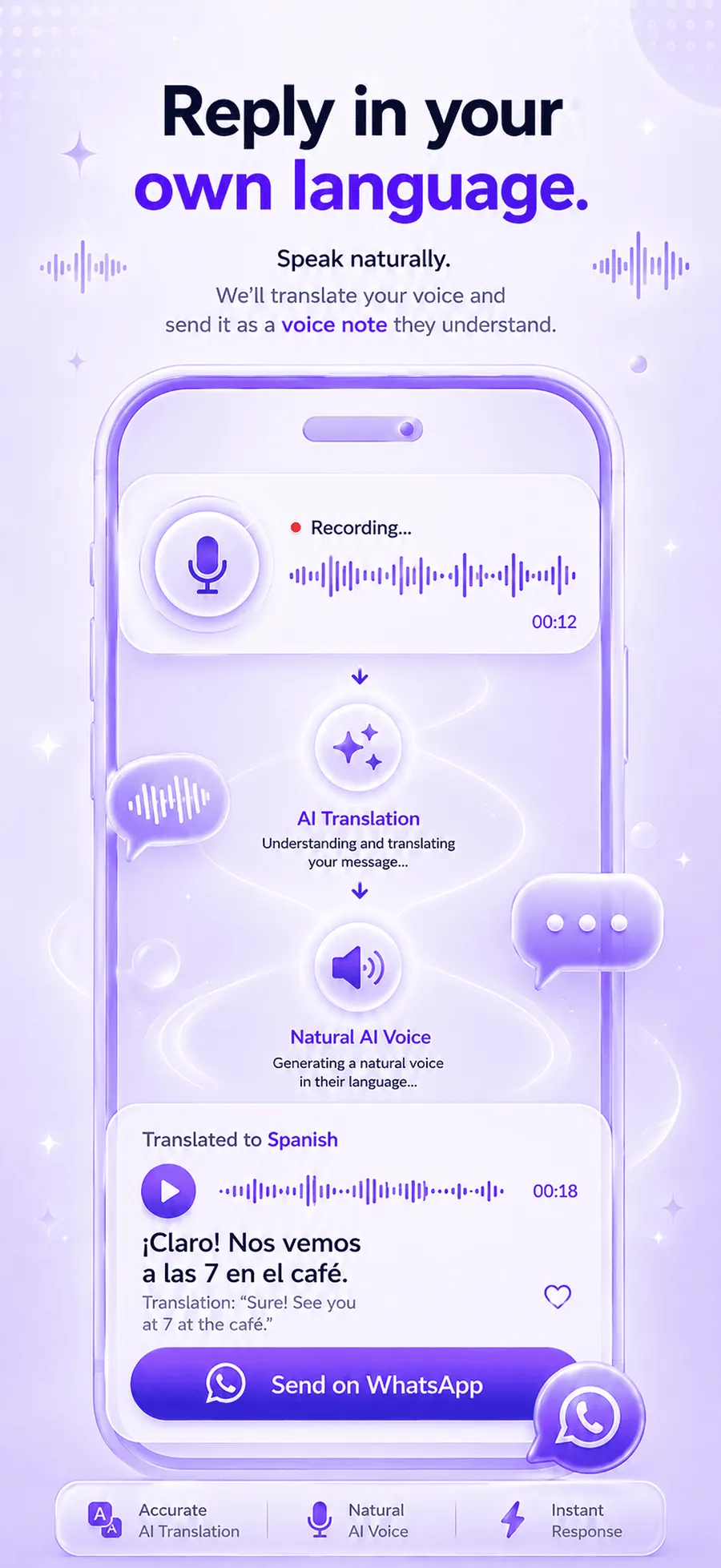
To translate Arabic voice to English, share the Arabic audio from WhatsApp, Telegram or any app into ReplyLingo, an iPhone and Android app that is free to start. For Arabic audio to English, ReplyLingo detects Arabic, transcribes it, translates it into English and reads the English aloud in a few seconds, and you can then record a reply in English that it speaks back in Arabic.
Why an Arabic voice note is harder than an Arabic text
An Arabic voice message is an audio file, so a text translator cannot do anything with it until the speech has been transcribed. Arabic also has no single spoken form: Egyptian, Gulf, Levantine and Maghrebi speech differ in vocabulary and pronunciation, and Arabic is written right to left in its own script, so even a transcript is hard to use if you cannot read it.
ReplyLingo goes from the audio straight to English, written and spoken. You do not need to read Arabic script or know which dialect the speaker uses.
How to translate an Arabic voice message to English
Understand the Arabic voice note
- 1Install ReplyLingo from the App Store or Google Play and continue as a guest.
- 2Press and hold the voice message in WhatsApp or any other app, then tap Share or Forward.
- 3Choose ReplyLingo from your phone's share sheet.
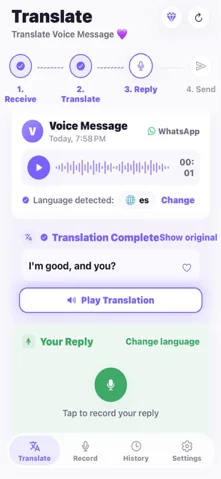
- 4Read the English transcript and listen to the English translation read aloud. ReplyLingo detects the Arabic for you.
Reply in Arabic without speaking Arabic
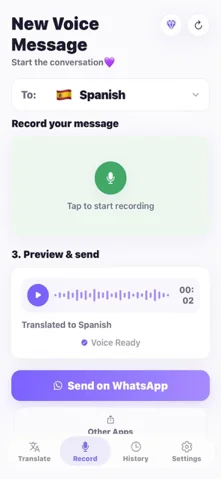
- 1Record your reply in English.
- 2ReplyLingo translates it and speaks it in Arabic.
- 3Send the audio back through the same chat from your share sheet.
Arabic dialects, and what to expect
ReplyLingo detects Arabic automatically. Recognition is generally strongest on clear speech that is close to standard Arabic and can be weaker on strong regional dialects, on Arabic mixed with English or French in the same sentence, and on recordings with noise or music. We do not publish accuracy numbers for individual dialects because we have not measured them.
For anything that matters, such as a price, a date, an address or a medical detail, treat the English as a very good first read and confirm it with the sender. If you reply by voice, the Arabic audio ReplyLingo speaks is in standard Arabic, which sounds more formal than everyday dialect.
Where Arabic voice messages usually come from
- WhatsApp: share the voice message from the chat to ReplyLingo.
- Telegram: forward or share the voice message the same way.
- Instagram: Instagram documents no Save or Share for a received voice message, so see our Instagram guide for the resend and playback-recording workarounds.
Who this helps
- Partners and spouses with Arabic-speaking families, especially relatives who prefer voice notes to typing.
- Teachers, tutors and landlords who communicate with Arabic-speaking parents and tenants.
- Freelancers, suppliers and customers working with clients across the Arab world.
- Colleagues and neighbours who send short Arabic voice notes and need a fast, reliable gist.
Tips for a clearer translation
- If the speaker mixes Arabic with English or French words, short clips give the cleanest result. Ask for a second clip if a name or number is unclear.
- A quiet recording gives better results. Music and street noise lower accuracy.
- For money, health, legal or safety details, confirm the important parts with the sender.
- ReplyLingo is built for voice messages of up to about three minutes and 15 MB.
Is it private?
Your conversation history stays on your device. ReplyLingo doesn't keep a server-side copy of your audio, transcripts or translations. The audio goes to AI providers (OpenAI and Google Cloud) only for the moment it takes to process the translation you asked for. The full details are in the privacy policy.
Ways to understand an Arabic voice message in English
How the usual options compare for an Arabic voice note you received.
| Option | English translation? | Spoken English? | Reply in Arabic? |
|---|---|---|---|
| ReplyLingo | Yes, from the audio | Yes, read aloud | Yes, record in English |
| WhatsApp voice message transcripts | No, Arabic text only, and only for a limited set of languages | No | No |
| Google Translate | Only if you can type out the Arabic | For typed text | No |
| Asking a bilingual friend | Yes, if they are around | Only by calling | If they help |
Related guides
Frequently Asked Questions
Understand every Arabic voice note
Free to start. No sign-up needed. Continue as a guest.